
Blog
Long-form guides on Indian tax, salary, finance and the regulations changing them.

Land Area Conversions: From Bigha to Sqft and Why It Matters
A clear guide to India's confusing traditional land units and why converting them to square feet matters. Covers the wide state-by-state variation in bigha (about 12,000 sq ft in MP, 14,400 in West Bengal and Assam, 17,424 in Gujarat and Rajasthan kaccha, 27,225 in Rajasthan pucca, and a startling 6,800 to 27,000 across districts of UP), so the same '5 bigha' can describe parcels differing three to four times in area. Explains the other regional units (marla and kanal in the north, guntha in the

Property Tax Late Payment Penalties: City-by-City Comparison
A city-by-city comparison of property tax late-payment penalties across India's major metros, and the under-discussed consequences of default. Covers the penalty rates (BBMP, BMC, and GHMC at 2% per month; MCD at 1% per month), how the 2% monthly penalty compounds (₹30,000 of unpaid tax becomes ₹38,000 after a year and ₹48,000 after two), the 24-month default cliff (Bengaluru's 100% penalty plus 15% interest, turning ₹60,000 into ₹1.38 lakh, followed by recovery proceedings — property attachment

RERA Buyer Protection: What Every Home Buyer Must Know
A practical guide to RERA — the Real Estate (Regulation and Development) Act, 2016 — and the protections every Indian home buyer has under it. Covers the core safeguards (carpet-area pricing instead of inflated super built-up area, 70% of buyer funds locked in a project-specific escrow account, legally binding possession dates, the 10% advance cap before the sale agreement, and a 5-year structural defect liability), a pre-RERA versus post-RERA comparison, and the practical how-to: verifying a pr

Stamp Duty Across Indian States: Where Property Registration Is Cheapest
A state-by-state comparison of stamp duty and registration charges across India for 2026. Total statutory cost on a ₹1 crore property ranges from about ₹4.9 lakh (a woman buyer in Gujarat) to ₹11 lakh (Tamil Nadu, at 7% stamp duty plus 4% registration) — over ₹6 lakh difference for the same-priced home. Includes the master comparison table (male and female rates) across 13 states, the cheapest and most expensive states, Maharashtra's distinctive four-tier system (Mumbai 6%/5%, Pune-Thane-Nagpur

Buying a Home in Bengaluru: Complete 2026 Cost Breakdown
The complete, component-by-component cost of buying a home in Bengaluru in 2026 — the pillar guide to what you actually pay beyond the sticker price. Covers Karnataka's statutory charges (stamp duty 5% plus 10% cess and 2% surcharge = 5.6% effective, registration now 2% after the 31 August 2025 doubling, totalling ~7.6%), the GST swing factor (5% on under-construction versus zero on ready-to-move and resale with an occupancy certificate — a ₹6 lakh difference on a ₹1.2 crore flat), Bengaluru set

Bonus Money Strategy: Where to Deploy Your Annual Performance Pay
A decision framework for deploying your annual bonus, ranked by risk-adjusted return. Starts with the overlooked reality that the bonus is post-tax (a ₹3 lakh bonus is ₹2.07 lakh in hand at 30% slab), then presents the core insight most people miss: home loan prepayment is a guaranteed, tax-free return equal to your loan rate — an 8.5% loan paid down is worth 12.1% pre-tax for a 30% slab taxpayer, matching equity's expected (but risky) ~12%. A ₹2.07 lakh prepayment on a ₹50 lakh/8.5%/20-year loa

FD Laddering: A Smarter Way to Use Bank Fixed Deposits
A practical guide to FD laddering for Indian savers. Covers the concrete ₹15 lakh example (three ₹5 lakh FDs at 1, 3, and 5 years), the honest both-directions math (laddering beats a single FD by ~₹33,000 over 5 years when rates rise, but a single long FD wins by ~₹30,000 when rates fall — so it's risk management, not guaranteed return maximisation), the consistent liquidity benefit (money frees up periodically without breaking an FD or paying a penalty), and the powerful DICGC insurance angle (

NPS Tier 1 vs Tier 2: When the Optional Account Makes Sense
A clear-eyed comparison of NPS Tier 1 and Tier 2 accounts. Tier 1 is the locked retirement account carrying all the tax benefits (80CCD(1), 80CCD(1B), 80CCD(2)); Tier 2 is the optional, fully-liquid add-on with the same ultra-low 0.09% cost but no tax deduction and slab-rate taxation on gains for private subscribers. The decisive math: despite Tier 2's lower cost, equity mutual funds beat it by ₹1.49 lakh on a ₹5 lakh/10-year investment for a 30% slab investor, because 12.5% LTCG beats slab-rate

Retirement Planning: How Much Money Do You Need at 60?
An honest, inflation-aware guide to retirement corpus planning for Indians. Covers the 25× rule and its India-adjusted version (3.5% withdrawal = 28.5×), the critical inflation reality most people miss (today's ₹6 lakh expenses become ₹25.8 lakh per year at retirement in 25 years), why ₹3-5 crore is the realistic floor and ₹7-10 crore for younger savers, the monthly SIP required by start age (₹6,158 at 25 vs ₹40,034 at 40 for ₹4 crore), the three corpus components (EPF at 8.25%, NPS, equity port

Sovereign Gold Bonds vs Physical Gold: Which Wins on Returns?
An honest comparison of gold investment routes for Indian investors in 2026. Sovereign Gold Bonds were the best gold instrument ever offered — 2.5% annual interest, zero making/storage costs, tax-free capital gains at maturity (₹10.66 lakh on a ₹5 lakh/8-year/9% scenario vs ₹9.03 lakh for gold ETF and ₹8.00 lakh for physical). But the RBI has issued no new tranches since February 2024 and none are scheduled for FY 2026-27 — the scheme is effectively paused. From April 2026, the tax-free maturity

Term Insurance: How Much Cover Do You Actually Need?
A practical guide to term insurance for Indian salaried earners — the two methods of calculating right cover (15-20× annual income, validated against needs analysis), two worked scenarios (30-year-old IT professional needing ₹3 crore, 35-year-old senior professional needing ₹2.5-3 crore), the brutal age-premium math (₹6-9K at 25, ₹30-45K at 45), why pure term beats ULIPs and whole-life by ₹60+ lakh of wealth over 25 years AND provides 10× more cover, the September 2025 GST 2.0 reform (individual

Health Insurance for Indians: Sum Insured, Top-up, Co-pay Decoded
A comprehensive guide to health insurance decisions for Indian middle-class families in 2026 — why ₹5 lakh employer cover is functionally inadequate against current metro hospitalisation costs (cardiac ₹15-25L, cancer ₹10-15L, organ transplants up to ₹80L), how the base + super top-up architecture delivers ₹65-75L of cover for ₹23-33K annually (₹12-17K cheaper than pure ₹50L base), the critical difference between top-up (per-claim deductible) and super top-up (annual aggregate), the silent cost-

Home Loan Prepayment: Reduce EMI or Reduce Tenure?
A computed walkthrough of the home loan prepayment decision — should you reduce EMI or reduce tenure? Includes verified math on a ₹50 lakh loan with ₹5 lakh prepayment at six different timings (year 1 through year 15), showing reduce-tenure consistently saves 2-3x more interest. Covers the honest counter-argument (Option B + invested EMI savings closes most of the gap at 12% returns), the behavioural reality (most borrowers don't maintain this investment discipline), the specific cases where red

EMI Burden: How Much of Your Salary Should Go to Loans?
A practical look at the EMI burden question — how the bank's FOIR ceiling (up to 50-55% of gross income) differs from the financial planner's 40% rule (on take-home income), why both views are mathematically valid for their objectives, and the long-term wealth opportunity cost of high EMI burden. Includes three concrete budget breakdowns at 30/40/50% EMI showing the ₹3.4 crore wealth gap over 25 years, the income-level sensitivity that makes 40% comfortable at high incomes but stressful at low i

Direct vs Regular Mutual Funds: Why Direct Saves You ₹20 Lakh
A focused deep-dive on Direct vs Regular Plan mutual funds — the single most consequential decision in Indian retail investing, and the one most people make wrong because it's invisible. Includes the verified 0.65 percentage point average expense gap for active equity funds, the full compounding math at multiple SIP sizes and durations (₹10K SIP for 25 years = ₹18.5 lakh gap; for 30 years = ₹41.5 lakh), the April 2026 SEBI reforms (TER → BER, lower index TER caps, tighter brokerage caps), the tr

How to Choose a Mutual Fund: A Practical 5-Filter Framework
A practical five-filter framework for selecting Indian mutual funds — category fit, fund size, expense ratio, manager tenure, and risk-adjusted returns — applied through two worked examples (large-cap and small-cap selection). Includes the verified direct-vs-regular plan math showing how a 1% expense ratio gap quietly costs ₹11-29 lakh over a 20-year SIP, the SPIVA India 2025 data on active vs index fund performance (73% of active large-cap underperformed over 10 years), and the operational 30-m

Liquid Funds vs Savings Account: Where to Park Your Emergency Fund
A practical, computed comparison of liquid funds and savings accounts for parking an emergency fund. Includes the post-tax math across all slabs on a ₹5 lakh emergency fund (showing ₹9,780/year advantage at 30% slab and ₹1.74 lakh cumulative over 10 years), the honest liquidity comparison (SEBI's ₹50,000 instant redemption + T+1 settlement), the post-2023 tax change that removed the LTCG indexation advantage, the sweep-in FD hybrid for single-bank simplicity, and the specific situations where sa

Best Investment Options for ₹10 Lakh: Risk-Adjusted 2026 Comparison
A practical, computed comparison of five investment options for ₹10 lakh — equity mutual funds, balanced advantage funds, fixed deposits, gold ETF, and real estate — with realistic 5/10/20-year projections, post-tax outcomes at 30% slab, three goal-based allocation frameworks, and the diversification math showing why a 60/20/10/10 portfolio beats pure equity for most investors. Includes the Budget 2026 update that effectively paused new Sovereign Gold Bond issuances and changed the tax treatment

Mutual Fund Returns: How to Read XIRR, CAGR, and Absolute Return
A clear breakdown of the three return metrics every mutual fund investor encounters — absolute return (ignores time), CAGR (right for lumpsums and fund comparison), and XIRR (right for SIPs and irregular cashflows). Includes worked examples showing why a 35% absolute return is the same as 6.21% naïve calculation but 12% actual XIRR, step-by-step instructions for computing your own XIRR in Excel or Google Sheets, and the reasons why fund houses publish CAGR but SIP investors need XIRR for their a

TDS on Rent: When Tenants Must Deduct Tax on Rental Payments
A transactional guide to TDS on rent for Indian tenants covering all three TDS regimes: Section 194-I for businesses (10% on land/building, threshold raised to ₹50,000/month by Finance Act 2025), Section 194-IB for individual tenants (2% rate since October 2024, single Form 26QC filing), and Section 195 for NRI landlords (30% plus cess, no threshold). Includes step-by-step Form 26QC filing instructions, the PAN-less landlord trap (20% TDS), the HRA-exemption invalidation risk, and the new Sectio

Restricted Stock Units (RSU) Tax in India: Two Tax Events Decoded
A detailed look at RSU taxation in India covering both tax events — perquisite at vesting (slab rate) and capital gains at sale (12.5% LTCG or higher STCG). Three computed scenarios show how Indian-listed and US-listed RSUs differ in tax treatment, holding period requirements, and disclosure obligations. Special attention to the Schedule FA disclosure requirement for foreign RSUs, the ₹10 lakh per year penalty under the Black Money Act, and the 2026 amnesty scheme for non-disclosure defaulters.

Section 80E Education Loan: Unlimited Deduction with One Catch
A detailed look at Section 80E — the unlimited education loan interest deduction that delivers some of the largest individual tax savings in the Indian tax code. Covers what qualifies, the 8-year cap that catches most people off-guard, the interest-only restriction, old-regime-only limitation, and three computed scenarios (engineering, MBA, foreign study) showing lifetime savings of ₹1.8 lakh to ₹16 lakh. Includes the planning insight that shorter loan tenures (within the 8-year window) capture

PPF vs NPS for Retirement: A 25-Year Corpus Comparison
A data-driven PPF vs NPS comparison with three scenarios — aggressive 30-year-old, moderate 40-year-old, conservative 50-year-old — showing where each instrument wins and by how much. Reveals the often-missed annuity drag on NPS, the EEE tax advantage of PPF, and why most balanced retirement portfolios should use both rather than picking one. Includes verified scenario math and tax treatment under both old and new regimes.

Emergency Fund: How Many Months of Expenses Do You Really Need?
A graduated framework for sizing your emergency fund based on employment type, family structure, and lifestyle commitments — from 3 months for government employees with dual income to 18 months for sole earners with high EMIs and dependents. Where to actually park it given the 2025-26 rate environment (RBI 5.25%, savings accounts at 2.75-3%, liquid funds at 6.5-7.5% with SEBI's ₹50,000/day instant redemption), and the career-optionality argument that makes emergency funds genuinely life-changing

How Much Should You Save Every Month? The 50-30-20 Rule for Indians
A practical, income-aware guide to the 50-30-20 budget rule for Indian salaried earners — why the standard percentages don't fit all incomes equally, realistic monthly allocations from ₹50,000 to ₹3 lakh take-home, how to categorise the gray-zone spending, and the variations (70-15-15, 60-20-20, 40-20-40) that fit different career stages. With practical guidance on where the savings allocation should actually go.

SIP vs Lumpsum Investment: Which Won Over the Last 10 Years?
A data-driven examination of the SIP vs lumpsum debate using three different 10-year Nifty 50 backtests. The math shows lumpsum wins decisively when you have the capital — by 49% to 74% across the test periods, even through major crashes. So why do advisers still recommend SIPs? The four practical reasons SIPs win in real life, and the Systematic Transfer Plan that most articles ignore but professionals recommend.

Beginner's Guide to Investing in India: From Zero to First SIP
The founding pillar for the Personal Finance silo — a complete beginner's framework for investing in India: the five-step sequence (emergency fund, health insurance, term life, equity SIPs, goal-based investing), the 100-minus-age asset allocation rule, why index funds beat active funds for most investors, the Direct vs Regular plan choice that costs lakhs over a lifetime, and realistic 5/10/20/30-year wealth projections.

Salary Restructuring for Tax Savings: A CA's Practical Playbook
A practical CA playbook for restructuring your salary to minimise tax in FY 2026-27 — component-by-component breakdown, the basic vs special allowance trade-off, income-level scenarios from junior to senior, and the major FY 2026-27 update: meal voucher exemption raised four-fold to ₹1,05,600 and now available in the new tax regime alongside employer NPS contribution.

Section 54 Property Reinvestment: How to Save Tax on a House Sale
A practical guide to eliminating capital gains tax on a property sale through reinvestment — how Sections 54, 54F, and 54EC differ, what you must reinvest under each, the time limits, the Capital Gains Account Scheme for parking funds during construction, the ₹10 crore cap, and the common pitfalls that reverse the exemption.

LTCG vs STCG: How Holding Period Determines Your Tax Bill
A clear guide to how holding period determines whether your capital gain is taxed as short-term (STCG) or long-term (LTCG) — the 12-month threshold for listed equity, 24 months for property and gold, and the concrete rupee impact of crossing the line. Includes worked examples showing how waiting two extra months can save ₹94,000 on equity or ₹5.46 lakh on property, plus the debt-fund and crypto exceptions that ignore holding period entirely.

Home Loan Tax Benefits: ₹2 Lakh Interest + ₹1.5 Lakh Principal Explained
A clear-eyed guide to home loan tax benefits for FY 2026-27 — the ₹2 lakh Section 24(b) interest deduction, the ₹1.5 lakh Section 80C principal deduction, and the uncomfortable truth that both are old-regime-only. Covers the let-out property asymmetry, the near-closed Section 80EEA window, the joint-loan doubling strategy, and why the new regime makes self-occupied home loans tax-disadvantaged.

Income Tax Act 2025: What's Changed from the 1961 Act
The definitive reference on the Income Tax Act, 2025 — what changed from the 1961 Act and what didn't. Covers the new Tax Year terminology, the comprehensive old-to-new section mapping (80C to 123, 80D to 126, 234B to 424, and more), renamed forms (Form 16 to 130, Form 12BB to 124), the genuinely substantive changes, and the transition rules governing which Act applies to which year.

80D Medical Insurance Deduction: How to Maximise the ₹1 Lakh Limit
A practical guide to the Section 80D / Section 126 medical insurance deduction, showing how the two independent buckets (self/family and parents) combine to deliver up to ₹1 lakh of annual deduction, the often-missed medical expenditure provision for uninsured senior parents, the preventive health check-up rule, and the family configurations that determine your actual ceiling.

UPS vs NPS: A Government Employees Decision Guide for the 2025 Choice
A rigorous analytical comparison of the Unified Pension Scheme and the National Pension System for central government employees, with actual corpus modeling at three career stages (5, 15, and 25 years to retirement), honest framing of the closed November 2025 election window, and the decision framework for new joiners who still face this choice within their first year.

TDS Rates FY 2026-27: Complete Section-by-Section Chart
A pillar reference covering every TDS provision applicable for FY 2026-27 under the consolidated Section 392/393/394 framework of the Income Tax Act, 2025. With the mapping from legacy 194X section numbers to new payment codes 1001-1067, current thresholds and rates, the 20% no-PAN rule, the abolition of Section 206AB, and the new Section 194T (partner payments) introduced from FY 2025-26.

How to File ITR-2 for AY 2027-28: For Capital Gains and Multiple Properties
A practical walkthrough of ITR-2 filing for AY 2027-28 — the form required when you have capital gains, multiple house properties, foreign assets, or other income that pushes you beyond ITR-1. Schedule-by-schedule guidance focused on the parts that actually require attention, the Schedule FA penalty risk that catches taxpayers off-guard, and the Section 87A rebate trap that surprises small investors at filing time.

Advance Tax Explained: Who Pays, How Much, and By When
A clear walkthrough of advance tax obligations under FY 2026-27 rules — who actually owes it (more salaried filers than they realise), the four-instalment schedule, the unforgiving Section 425 interest that applies even when you pay full liability by year-end, and the specific situations where salaried employees get caught off-guard.

Tax Saving Investments Compared: ELSS vs PPF vs NPS vs FD
A grounded comparison of the four major Section 80C tax-saving instruments — ELSS, PPF, NPS, and tax-saver FD — for FY 2026-27. With lock-in periods, post-tax return calculations at the 30% slab, and a clear ranking of which instruments deserve a place in a sensible portfolio versus which exist primarily as tax-saving traps.

Old vs New Tax Regime: Which Wins at Each Income Level (₹5L to ₹50L)
A comprehensive analysis of when the old tax regime beats the new tax regime for FY 2026-27, with exact breakeven deduction amounts at each income level from ₹5 lakh to ₹50 lakh. Includes the tax computation table, realistic deduction profiles, and the decision framework that cuts through the depends-on-your-situation non-answers most articles give.

Standard Deduction in India: ₹50,000 vs ₹75,000 Across Tax Regimes
A clear walkthrough of India's standard deduction for FY 2026-27. Why the new regime gets ₹75,000 versus the old regime's ₹50,000, the family pension variation under Section 57(iia), the historical arc since 1974, and how to think about the standard deduction when choosing your tax regime.

NPS Tax Benefits: How to Save ₹2 Lakh Under 80C and 80CCD
A clear walkthrough of how the three NPS-related tax sections — 80CCD(1), 80CCD(1B) and 80CCD(2) — combine to enable a ₹2 lakh personal deduction in the old regime, and how the 14% employer contribution rule under 80CCD(2) makes NPS valuable even in the new regime where personal deductions don't apply.

Form 16 Decoded: Every Field Explained for Salaried Employees
A field-by-field walkthrough of Form 16 Part A (TRACES-generated) and Part B (employer-prepared) for salaried taxpayers. Covers cross-checks against Form 26AS and AIS, common errors, the resolution path when something is wrong, and the upcoming transition to Form 130 from Tax Year 2026-27.

Section 87A Rebate: Why ₹12 Lakh Income Is Truly Tax-Free Now
A clear walkthrough of how the Section 87A rebate of ₹60,000 makes income up to ₹12 lakh effectively tax-free under the new regime, why salaried filers get to ₹12.75 lakh, the marginal relief mechanic that smooths the threshold, and the critical caveat that capital gains and other special-rate income don't get the rebate.

Cryptocurrency Tax in India 2026: The 30% Reality That Crushes Profitable Traders
A grounded analysis of how India's crypto tax framework — flat 30% under Section 115BBH, 1% TDS under Section 194S, no loss offset, no expense deduction — actually works in practice. With concrete trader P&L examples showing why the headline rate hides a much harsher reality.

Capital Gains Tax Post-Budget 2024: What Actually Changed for Investors
A grounded analysis of the Budget 2024 capital gains tax changes that took effect from 23 July 2024 and continue into FY 2026-27. Covers LTCG/STCG rate harmonisation, the property dual-rate option for pre-23 July purchases, holding period changes, debt fund treatment, loss set-off rules, and Section 54/54F/54EC reinvestment exemptions.

8th Pay Commission: Will Government Salaries Really Double by 2028?
A grounded analysis of what central government employees and pensioners can realistically expect from the 8th Central Pay Commission. Cuts through the fitment-factor hype to show the actual likely net cash hike, with the historical pattern from 5th, 6th and 7th CPCs as anchor.

TDS on Salary Explained: Why Your First Month Take-Home is Different
A clear walkthrough of how TDS on salary is calculated under Section 392 of the new Income Tax Act, 2025. Covers the joining-month, bonus-month, and final-quarter swings most salaried employees experience without ever getting a clean explanation.

How to File ITR-1 for AY 2027-28: Step-by-Step Guide for Salaried Employees
Complete walkthrough of ITR-1 (Sahaj) filing for AY 2027-28, the first ITR cycle under the new Income Tax Act, 2025. Eligibility rules, the seven-step e-filing flow, the new section number references, deadlines, common mistakes, and answers to the most frequent filing questions.

How Much Will Your Salary Increase Under the 8th Pay Commission?
The 8th Pay Commission could raise your salary anywhere from 42% to 160% — depending on which fitment factor the government accepts. Here's the timeline, the math, and how to run the numbers for your pay level.

Tax-Saving Investments Compared: ELSS vs PPF vs NPS vs Tax-Saver FD
Every 80C option side-by-side — returns, lock-in, risk and tax treatment on maturity.

SIP vs Lumpsum: Which Wins for ₹10 Lakh Over 10 Years?
An honest data-driven look at the SIP vs lumpsum debate — with the markets where each strategy actually wins.
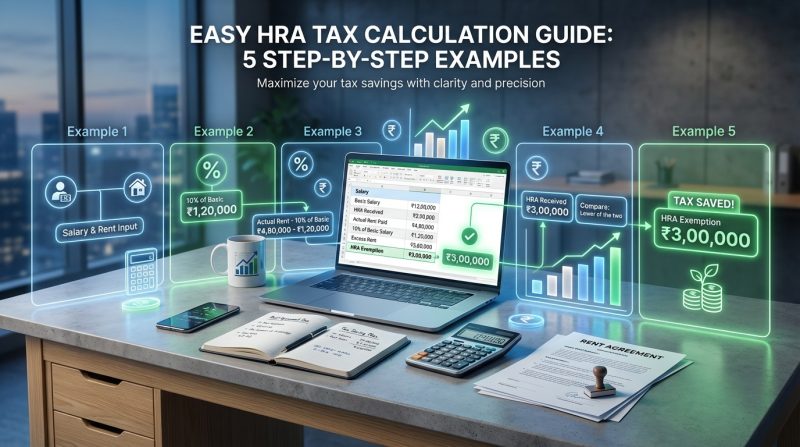
HRA Exemption Calculation Guide with 5 Worked Examples
How Section 10(13A) works, the "least of three" rule, and five scenarios showing exactly how much HRA you can claim.

Old vs New Tax Regime FY 2026-27: Which Saves You More at ₹15 Lakh?
A decision framework for picking your regime — with the exact deduction threshold where old beats new at every income level.

Complete Guide to Income Tax in India for FY 2026-27
Everything salaried Indians need to know for FY 2026-27 — new slabs, the Income Tax Act 2025 changes, regime comparison, rebates and worked examples.